Larceny in New Mexico: What the Charge Means and What to Do Next
Charged with larceny in New Mexico? Don’t face it alone. Raymon Law Group offers confidential case review, and our criminal defense team is available 24/7.
A bag of groceries that never got scanned. A phone you picked up at a party and honestly thought was yours. A tool you took home from a job site and never brought back. None of these feels like a crime to the person involved, but any of them can end in a larceny charge in New Mexico.
Larceny is simply the legal word for theft here, and how a prosecutor charges it depends almost entirely on one thing: what the property was worth. Take something worth $200 and it’s a petty misdemeanor. Take something worth $3,000 and it’s a felony that can mean years in prison.
This guide covers how larceny works under New Mexico law, what the penalties look like, which defenses come up most, and what to do if you’re facing a charge in Albuquerque, Santa Fe, or anywhere else in the state.
New Mexico’s larceny law, Section 30-16-1 of the state code, defines the crime in one short line: stealing anything of value that belongs to another person. That covers cash, a car stereo, a laptop, even livestock. It also covers the things people don’t think of first, like a package pulled off a porch or merchandise carried out of a store without paying.
To convict you, the state has to show more than that something went missing. In general, a prosecutor has to prove that you took property that wasn’t yours, that you meant to keep it from its owner for good, and what it was worth. That middle piece, intent, is where many larceny cases get complicated. Walking off with someone’s jacket by mistake is not the same as meaning to steal it, and the law treats those two situations very differently.
What a larceny conviction really costs?
Jail or prison is the headline risk, but it’s rarely the only one. Even a low-level conviction can bring probation, fines, and an order to pay the owner back. Then there’s the record, which can follow you for years.
Background checks are routine now. Employers run them, landlords run them, and so do colleges. A theft conviction tends to raise questions about honesty, and that can hurt a job application or a rental approval long after the case is closed. For a felony, the damage goes further.
That’s why it makes sense to take even a small charge seriously. If yours is a lower-level case, our misdemeanor defense team can walk you through the options. If it crosses into felony territory, our felony defense attorneys handle those cases too.
How the value of the property sets the charge
New Mexico doesn’t have separate crimes for “small theft” and “big theft.” It has one larceny statute with a sliding scale, and the dollar value of what was taken decides where you land.
Value of property
Charge
Maximum penalty
$250 or less
Petty misdemeanor
Up to 6 months in jail, $500 fine
Over $250 up to $500
Misdemeanor
Up to 1 year in county jail, $1,000 fine
Over $500 up to $2,500
Fourth-degree felony
Up to 18 months in prison, $5,000 fine
Over $2,500 up to $20,000
Third-degree felony
Up to 3 years in prison, $5,000 fine
Over $20,000
Second-degree felony
Up to 9 years in prison, $10,000 fine
The line between $500 and $501 matters more than most people realize. Cross it and a misdemeanor becomes a felony, with everything that comes with that label.
Two exceptions sit outside the table. Stealing livestock is a third-degree felony no matter what the animal is worth, and each animal counts as its own offense. Firearms also get their own, harsher treatment.
A maximum is a ceiling, not a prediction. What actually happens depends on the facts, your history, and how the case is resolved. And the value itself is often up for debate: is it what the store charges, what the item would fetch used, or what the owner says it’s worth? A good defense lawyer looks hard at how the state arrived at its number, because moving it across one of these lines can change the whole case.
Larceny, shoplifting, burglary, robbery and embezzlement: how they differ
People use these words as if they meant the same thing. Prosecutors don’t, and the label on your charge changes both the penalties and the way a defense gets built.
Shoplifting: taking merchandise from a store without paying. It’s the version of larceny most people picture, and the value of the items still plays a big role in how serious it gets.
Burglary: going into a home, building or vehicle without permission, intending to steal or commit another felony inside. Nothing has to be taken for burglary to be charged.
Robbery: taking something from a person by force or the threat of force. The violence element makes it a much more serious crime than plain larceny.
Embezzlement: keeping property you were trusted to handle, such as an employer’s cash or a client’s funds. Our page on embezzlement defense goes deeper on this one.
Receiving stolen property: holding or selling something you knew, or had good reason to believe, was stolen.
At Raymon Law Group, a larceny case starts with the facts, not a script. We go through the police report and the evidence, find where the state’s story is thin, and build a defense around your situation. Depending on the case, that can mean pushing for dismissal, negotiating a reduced charge, looking at alternatives to jail, or taking the case to trial.
The first conversation is a free, confidential case review, and our criminal defense team is available around the clock. If you or someone in your family is facing a larceny charge, call (505) 390-1040 or contact us online and we’ll talk through where you stand. Every case is different, and no lawyer can promise a particular outcome, but you shouldn’t have to face the system alone.
Location Served
We Represent Individuals & Families throughout New Mexico
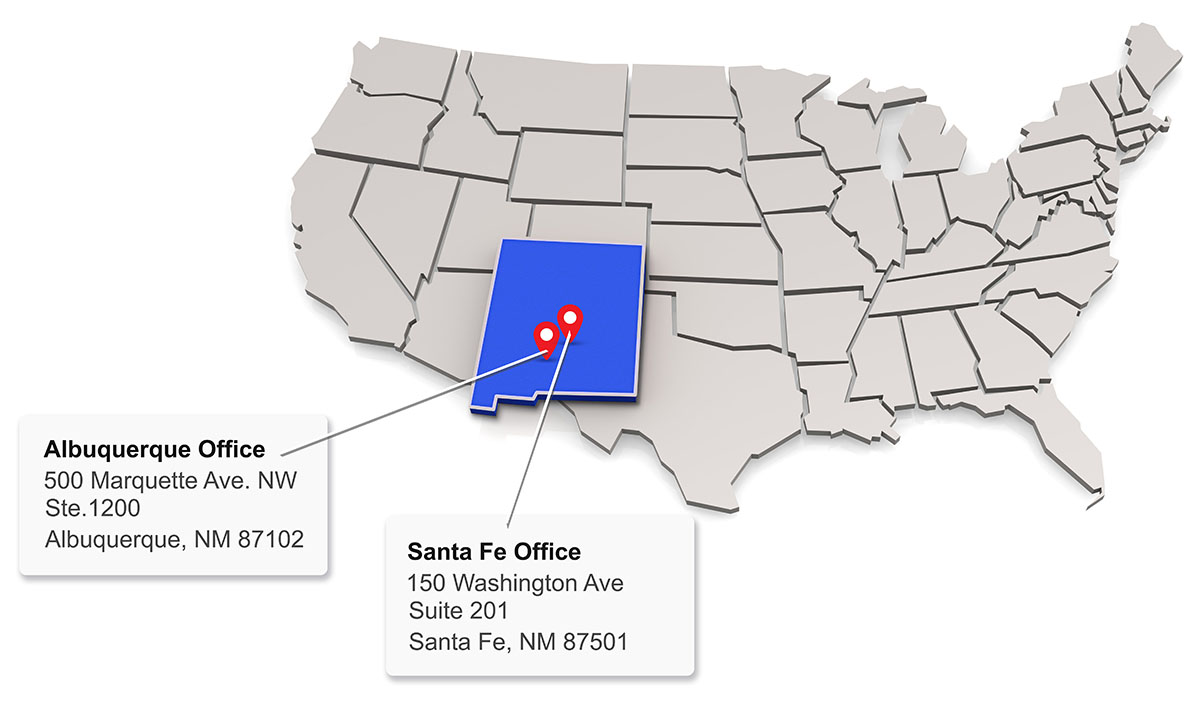
We also have our Office at Santa Fe located at 150 Washington Ave, Suite 201. If you’re unable to visit us, our attorneys are happy to meet you at your home or hospital to discuss your case.
It can be. Property worth $500 or less is charged as a misdemeanor or petty misdemeanor. Anything above $500 is a felony, and stealing livestock is a felony no matter the value.
In everyday talk, yes. In New Mexico, larceny is the core theft offense. Related crimes like shoplifting, embezzlement and receiving stolen property are charged under their own rules.
Sometimes. Weak evidence, mistakes in the investigation, a disputed value, or negotiation with the prosecutor can all lead to a dismissal or a lesser charge. Nothing is guaranteed, which is why the details of your case matter.
Giving something back doesn’t automatically end a case. Prosecutors still decide whether to pursue it, though a return can matter when intent and settlement are discussed. Talk to a lawyer before contacting the owner, because well-meant attempts to fix things can backfire.
It’s worth at least a conversation. Even a petty misdemeanor can leave a record that shows up in background checks, and a lawyer can tell you whether the charge is as simple as it looks.