What Happens After You Are Arrested for a Felony in New Mexico?
Learn what happens after a felony arrest in New Mexico and understand your legal rights. Contact Raymon Law Group today to discuss your defense options and protect your future.
A felony arrest can have serious consequences, but an arrest is not a conviction. You have the right to challenge the allegations, examine the evidence, and defend yourself throughout the criminal justice process.
Understanding your rights and getting legal guidance early can make an important difference in how you approach your case.
If you are facing felony charges in Albuquerque, Santa Fe, or elsewhere in New Mexico, Raymon Law Group is available to discuss your legal concerns.
Call our Felony Defense Lawyer in New Mexico page to learn more about your legal options.
What Happens After You Are Arrested for a Felony in New Mexico?
Being arrested for a felony in New Mexico can be overwhelming. You may be worried about going to jail, losing your job, damaging your reputation, or facing a criminal record that could affect your future. You may also have questions about what happens next, how long the legal process takes, and whether you can fight the charges against you.
Understanding what happens after a felony arrest can help you make informed decisions and protect your legal rights.
In New Mexico, a felony case may involve several stages, including arrest and booking, an initial court appearance, a decision about pretrial release or detention, a preliminary hearing or grand jury indictment, arraignment, pretrial motions, and potentially a trial or plea agreement.
Each case is different. The process depends on the nature of the allegations, the available evidence, the defendant’s circumstances, and how the prosecution chooses to proceed.
If you or someone you care about has been arrested for a felony, Raymon Law Group can help you understand your legal options and develop a defense strategy based on the circumstances of your case.
What Is Considered a Felony in New Mexico?
A felony is a serious criminal offense that carries the possibility of imprisonment in state prison, along with other legal consequences. New Mexico classifies most felonies into four degrees, with first-degree felonies generally carrying the most severe penalties and fourth-degree felonies generally carrying the least severe penalties.
Examples of offenses that may be charged as felonies include:
Violent crimes: Aggravated assault, aggravated battery, robbery, and homicide.
Drug offenses: Certain controlled substance possession, distribution, manufacturing, and trafficking offenses.
Property crimes: Burglary, certain theft offenses, and serious property-related offenses.
White-collar crimes: Embezzlement, fraud, identity theft, and certain financial offenses.
Sex crimes: Sexual assault, criminal sexual penetration, and certain offenses involving minors.
Repeat DWI offenses: Certain repeat DWI offenses can be charged as felonies under New Mexico law.
The specific classification and potential punishment depend on the criminal statute, the facts of the case, and any applicable sentencing enhancements.
A felony arrest does not mean you have been convicted. The prosecution must establish the required elements of the charged offense, and you have the right to defend yourself throughout the criminal proceedings.
What Happens Immediately After a Felony Arrest in New Mexico?
After an arrest, law enforcement generally takes the individual into custody and begins the booking process. However, an arrest and a formal criminal charge are not necessarily the same thing.
Here are some of the steps that may follow.
1. Arrest and Booking
Following a felony arrest, the individual is generally transported to a local detention facility or jail for booking.
During booking, law enforcement may:
Record the individual’s personal information.
Take fingerprints and photographs.
Document the alleged criminal offense.
Conduct an inventory of personal belongings.
Check for outstanding warrants.
Complete necessary arrest and detention paperwork.
The person may remain in custody while the case proceeds, depending on the circumstances and the court’s release decision.
What you should do: Avoid discussing the facts of the alleged offense with law enforcement or other people without first speaking with a defense attorney. You have the constitutional right to remain silent, and statements you make may be used against you.
2. Initial Court Appearance
After an arrest, the defendant must be brought before a court for an initial appearance.
During this proceeding, the judge generally explains important information, including:
The criminal offense alleged against the defendant.
The potential penalties associated with the charge.
The right to legal representation.
The right to remain silent.
The possibility of pretrial release or detention.
The right to a preliminary examination, when applicable.
The initial appearance is an important opportunity to understand the allegations and the legal process ahead.
If you cannot afford an attorney, you may qualify for court-appointed representation, depending on your financial circumstances and applicable eligibility requirements.
3. Pretrial Release or Detention Decision
One of the biggest concerns following a felony arrest is whether the defendant will remain in jail or be released while the case is pending.
New Mexico courts follow constitutional and procedural rules governing pretrial release. The court generally considers the least restrictive conditions necessary to reasonably assure the defendant’s appearance in court and protect public safety.
Depending on the circumstances, release conditions may include:
Regular check-ins with pretrial services.
Restrictions on travel.
Electronic monitoring.
Restrictions on contact with certain individuals.
Substance testing or treatment requirements.
Other court-ordered conditions.
In certain cases, the prosecution may request pretrial detention. The court must evaluate the applicable legal requirements and evidence before ordering detention.
A defense attorney can review the circumstances and advocate for appropriate release conditions.
Important: Release is not automatic. The decision depends on the facts, applicable law, and the court’s assessment of the case.
4. Preliminary Hearing or Grand Jury Indictment
After the initial court proceedings, the prosecution must establish a legally sufficient basis for moving forward with felony charges.
In New Mexico, a felony prosecution may proceed through a preliminary examination followed by the filing of a criminal information, or through a grand jury indictment.
These are two different procedures.
Preliminary Hearing
A preliminary hearing allows a judge to evaluate whether probable cause exists to believe that a felony offense was committed and that the defendant committed it.
During this hearing:
The prosecution presents evidence and may call witnesses.
The defense may challenge the evidence and cross-examine witnesses.
The judge evaluates whether probable cause supports the felony charge.
Under New Mexico Rule 5-302, a preliminary examination generally must be scheduled and held within:
10 days if the defendant is in custody.
60 days if the defendant is not in custody.
Certain circumstances and authorized extensions may affect these deadlines.
If the judge finds sufficient probable cause, the case may be bound over for further proceedings. If probable cause is not established, the affected felony charges may be dismissed without prejudice, meaning the prosecution may have another opportunity to pursue them through a legally permitted process.
Grand Jury Indictment
A grand jury is another way for the prosecution to pursue felony charges.
A grand jury reviews evidence presented by the prosecution and determines whether probable cause supports an indictment.
Unlike a preliminary hearing, grand jury proceedings generally take place without the defendant or defense attorney participating in the presentation of evidence.
If the grand jury returns an indictment, the prosecution can proceed with the felony case in district court.
Why this stage matters: The way the prosecution establishes the charges can affect the next steps in the case. A defense attorney can evaluate the evidence, identify potential legal issues, and determine what challenges may be available.
5. Arraignment and Entering a Plea
Once formal felony charges are filed in district court, the defendant generally appears for arraignment.
During arraignment, the court formally addresses the charges, and the defendant enters a plea.
Common pleas include:
Not Guilty: The defendant contests the allegations, requiring the prosecution to prove the charges beyond a reasonable doubt if the case proceeds to trial.
Guilty: The defendant admits guilt to the charged offense or offenses.
No Contest: The defendant does not contest the charge, with the legal consequences determined under applicable law.
Before entering a guilty or no-contest plea, it is important to understand the possible penalties and other consequences.
A felony conviction can affect employment, professional licensing, housing, immigration status, and other aspects of your life.
You should not feel pressured to enter a plea before discussing your options with a qualified criminal defense attorney.
6. Discovery and Pretrial Motions
After formal charges are filed, the defense and prosecution prepare for the next stages of the case.
This process generally includes discovery, where the parties exchange information and evidence according to applicable procedural rules.
Evidence may include:
Police reports and arrest records.
Witness statements.
Surveillance footage and photographs.
DNA or fingerprint evidence.
Medical records.
Digital communications.
Search warrants and related documentation.
Laboratory reports and expert findings.
Your defense attorney can review the available evidence to determine whether the prosecution’s case has weaknesses.
Pretrial motions may also be filed to address legal issues before trial.
For example, a defense attorney may challenge:
Evidence obtained through an unlawful search or seizure.
Statements allegedly obtained in violation of constitutional rights.
Unreliable witness identification.
Improper investigative procedures.
Evidence that should be excluded under applicable rules.
If the court grants a motion to suppress important evidence, it may significantly affect the prosecution’s ability to prove the case.
Not every case requires the same motions or defense strategy. The appropriate approach depends on the evidence and legal circumstances.
7. Plea Negotiations or Criminal Trial
Not every felony case goes to trial. Depending on the evidence and circumstances, the prosecution and defense may discuss a plea agreement.
A plea agreement may involve:
Reducing the original felony charge.
Dismissing certain charges.
Recommending a particular sentence.
Resolving multiple criminal allegations through an agreement.
Any agreement must be evaluated carefully. A reduced charge or recommended sentence does not automatically make a plea the best option.
If the case does not resolve through a plea agreement, it may proceed to trial.
What Happens During a Felony Trial?
During a criminal trial, the prosecution must prove every required element of the charged offense beyond a reasonable doubt.
The trial may involve:
Jury selection.
Opening statements.
Presentation of prosecution evidence.
Cross-examination of witnesses.
Presentation of defense evidence, if appropriate.
Closing arguments.
Jury deliberations and a verdict.
The defendant has the constitutional right to a jury trial in qualifying cases. The defendant may also have the option of a bench trial, depending on applicable procedural requirements.
If the jury finds the defendant not guilty, the defendant is acquitted of the charges tried. If the defendant is found guilty, the case proceeds to sentencing.
8. Sentencing After a Felony Conviction
If a defendant pleads guilty or is found guilty at trial, the court determines the appropriate sentence under New Mexico law.
Potential consequences may include:
Imprisonment.
Probation, when legally available.
Fines and court costs.
Restitution to victims.
Court-ordered treatment or other conditions.
Additional consequences required by the specific offense.
The sentence depends on the felony classification, applicable sentencing statutes, prior convictions, aggravating or mitigating circumstances, and other legally relevant factors.
New Mexico also has habitual offender provisions that can increase certain sentences based on qualifying prior felony convictions.
A defense attorney can review the applicable sentencing law and present relevant information on your behalf.
Felony Defense in New Mexico
What Should You Do After Being Arrested for a Felony?
1. Do Not Discuss Your Case With Others
Avoid discussing the allegations on social media, through text messages, or with individuals who may later become witnesses. Statements and communications may become evidence.
2. Do Not Ignore Court Dates
Attend all required court appearances and follow the conditions of release. Missing a hearing can result in additional legal problems, including an arrest warrant.
3. Preserve Potential Evidence
Keep relevant documents, photographs, messages, contact information, and other information that may help your attorney understand the circumstances. Do not delete, alter, or destroy potential evidence.
4. Follow All Release Conditions
If the court releases you while the case is pending, follow every condition carefully. Violating release conditions can lead to additional restrictions or detention.
5. Protect Your Legal Rights
Do not consent to searches without first understanding your rights. You can invoke your right to remain silent and request an attorney before answering questions about the allegations.
6. Speak With a Criminal Defense Attorney
A felony charge can carry serious consequences. An attorney can review the allegations, explain the process, identify potential defenses, and help you understand the options available.
What Are Your Rights After a Felony Arrest in New Mexico?
Being arrested does not mean you lose your constitutional rights. Even when facing serious criminal allegations, you retain important legal protections.
These include:
The Right to Remain Silent
You generally do not have to answer questions about the alleged crime. You can clearly state that you wish to remain silent and want to speak with an attorney.
The Right to an Attorney
You have the right to legal representation during critical stages of criminal proceedings. If you cannot afford an attorney, you may qualify for appointed counsel.
Protection Against Unreasonable Searches and Seizures
The Fourth Amendment and applicable New Mexico law protect individuals against unreasonable government searches and seizures. Evidence obtained unlawfully may be subject to a legal challenge.
The Right to Due Process
The government must follow the applicable legal procedures when investigating and prosecuting criminal allegations.
The Right to a Fair Trial
The prosecution must prove the charges beyond a reasonable doubt at trial. You are presumed innocent unless and until proven guilty.
Understanding these rights is important because decisions made early in a felony case can affect the defense strategy later.
Why Hire Raymon Law Group for Felony Defense in New Mexico?
Facing a felony charge can put your freedom, reputation, and future at risk. Having legal representation can help you understand the criminal justice process and make informed decisions at every stage.
At Raymon Law Group, our criminal defense practice represents individuals facing serious criminal allegations throughout New Mexico.
Our felony defense practice handles a range of criminal matters, including:
Every criminal case has different facts and legal issues. A defense strategy should be based on the evidence, applicable law, and the circumstances surrounding the arrest.
Our goal is to protect your legal rights and pursue the best available outcome based on the facts of your case.
If you or a loved one has been arrested for a felony, contact Raymon Law Group to discuss your situation.
Frequently Asked Questions About Felony Arrests in New Mexico
The length of time a person remains in custody depends on the circumstances of the arrest, the initial court proceedings, and the court’s pretrial release or detention decision. Some individuals may be released under conditions, while others may remain detained if the court orders pretrial detention under applicable law.
Yes. Felony charges may be dismissed if the prosecution cannot establish the required legal basis, important evidence is excluded, or other legal grounds support dismissal. However, an arrest alone does not guarantee that charges will be dismissed.
Possibly. New Mexico courts consider pretrial release under applicable constitutional and procedural rules. A judge may order release with conditions or, in qualifying cases, order pretrial detention following the required proceedings.
No. Some felony cases are resolved through plea agreements, while others may be dismissed or resolved through other legally available outcomes. A case proceeds to trial when it is not otherwise resolved and the parties move forward with trial proceedings.
A grand jury indictment formally charges the defendant with the specified offenses. The case generally proceeds in district court, where the defendant is arraigned and the prosecution and defense prepare for further proceedings.
It is advisable to speak with a criminal defense attorney as soon as possible after a felony arrest. Early legal representation can help protect your rights, address pretrial release issues, evaluate the evidence, and prepare an appropriate defense strategy.
Location Served
We Represent Individuals & Families throughout New Mexico
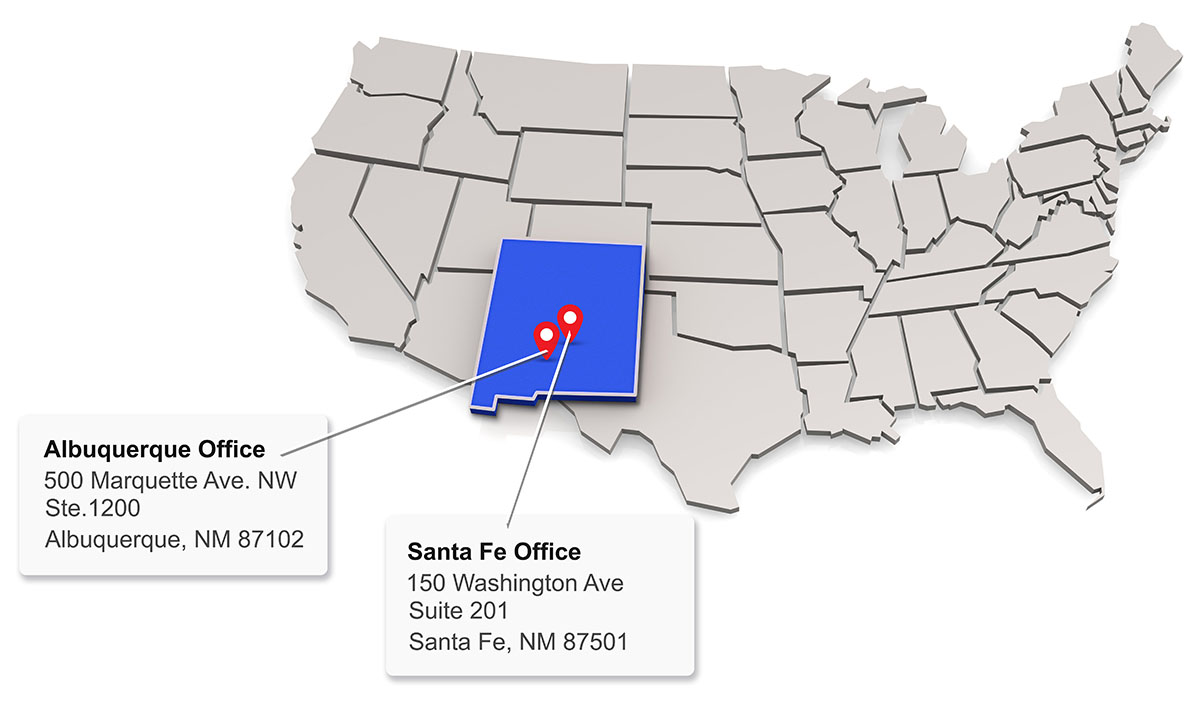
We also have our Office at Santa Fe located at 150 Washington Ave, Suite 201. If you’re unable to visit us, our attorneys are happy to meet you at your home or hospital to discuss your case.